Battleships Cans
Battleships Cans
A fun, interactive activity game that connects Gen Z and encourages recycling.
A fun, interactive activity game that connects Gen Z and encourages recycling.
A fun, interactive activity game that connects Gen Z and encourages recycling.
Role
Researcher & Designer
Researcher & Designer
Researcher & Designer
Duration
6 weeks (2024)
Team
Tara Savage, Stephen Barun and Maria Akalata
Tara Savage, Stephen Barun and Maria Akalata
Tara Savage, Stephen Barun and Maria Akalata
Collaboration
NCAD, Accenture The Dock
NCAD, Accenture The Dock
NCAD, Accenture The Dock

See the process
Why this project
Why this project
Gen Z is the most connected generation, and one of the loneliest.
Gen Z is the most connected generation, and one of the loneliest.
The World Health Organisation now treats loneliness as a global health concern, on the same level as physical illness. Between 5 and 15% of adolescents experience it directly.
The cause isn't a lack of digital connection. It's a shortage of real ones.
The World Health Organisation now treats loneliness as a global health concern, on the same level as physical illness. Between 5 and 15% of adolescents experience it directly.
The cause isn't a lack of digital connection. It's a shortage of real ones.


The Problem
The Problem
Third spaces still exist. People have stopped using them to connect.beforehand
Third spaces still exist. People have stopped using them to connect.beforehand
Cafes, libraries, parks, clubs, the places built for people to gather are still there. What's changed is whether anyone actually connects in them.
Research pointed to why. Breaking into a group that already exists is hard. Spaces sit under-used, not because they've vanished, but because no one's giving people a reason or a way in. And litter pushes people out of the shared spaces meant to bring them together.
Cafes, libraries, parks, clubs, the places built for people to gather are still there. What's changed is whether anyone actually connects in them.
Research pointed to why. Breaking into a group that already exists is hard. Spaces sit under-used, not because they've vanished, but because no one's giving people a reason or a way in. And litter pushes people out of the shared spaces meant to bring them together
The real problem isn't a lack of places to go. It's a lack of a reason to talk to whoever's already there.
The real problem isn't a lack of places to go. It's a lack of a reason to talk to whoever's already there.
Third Spaces
Research
Research
Understanding third spaces and how Gen Z uses them.
Understanding third spaces and how Gen Z uses them.
The approach
I was part of the Third Spaces research group:
12 interviews with Gen Z
Observation of existing third spaces around inner-city Dublin
Secondary research of existing apps
To review what's already out there and where the disconnect is.
I was part of the Third Spaces research group:
12 interviews with Gen Z
Observation of existing third spaces around inner-city Dublin
Secondary research of existing apps
To review what's already out there and where the disconnect is.
I was part of the Third Spaces research group:
12 interviews with Gen Z
Observation of existing third spaces around inner-city Dublin
Secondary research of existing apps
To review what's already out there and where the disconnect is.


Key Findings
Key Findings
Four things stood out.
Four things stood out.
Anxiety stops people before they even try connect.
Anxiety stops people before they even try connect.
In interviews, the barrier wasn't a lack of places or people, it was the moment of walking up to a stranger and starting a conversation. That single moment was where most people froze.
In interviews, the barrier wasn't a lack of places or people, it was the moment of walking up to a stranger and starting a conversation. That single moment was where most people froze.
Connection has to feel authentic, not engineered.
Connection has to feel authentic, not engineered.
People didn't want forced icebreakers or anything that felt like a structured exercise. They wanted something that gave them a real reason to talk, not a script.
People didn't want forced icebreakers or anything that felt like a structured exercise. They wanted something that gave them a real reason to talk, not a script.
Third spaces already exist, they're just under-used.
Third spaces already exist, they're just under-used.
The infrastructure for connection is there. The reason to use it isn't.
The infrastructure for connection is there. The reason to use it isn't.
Littering pushes people out of shared spaces.
Littering pushes people out of shared spaces.
No one wants to spend time somewhere that feels dirty or neglected.
No one wants to spend time somewhere that feels dirty or neglected.
The insight that shaped everything
The insight that shaped everything
Approaching a stranger cold is the hardest part. Litter is what makes shared spaces feel unwelcome in the first place.
Put those together, and the answer wasn't a new app or a new space. It was something physical, sitting in a space people already use, that gives two strangers a reason to talk without either of them having to make the first move alone. Turning waste into that reason is the idea we tested.
Approaching a stranger cold is the hardest part. Litter is what makes shared spaces feel unwelcome in the first place.
Put those together, and the answer wasn't a new app or a new space. It was something physical, sitting in a space people already use, that gives two strangers a reason to talk without either of them having to make the first move alone. Turning waste into that reason is the idea we tested.
Development
Development
Concept Creation
Concept Creation
Thirty concepts, one answer
Thirty concepts, one answer
As a team we generated 30 concepts in total. Rather than picking favourites, we grouped them by the themes that kept reappearing, and refined each into one strong direction to prototype and test with real users.
As a team we generated 30 concepts in total. Rather than picking favourites, we grouped them by the themes that kept reappearing, and refined each into one strong direction to prototype and test with real users.
Concept 1: TryPal
Concept 1: TryPal
An app connecting people through shared activities, encouraging users to step outside their comfort zone and earn rewards for trying something new.
An app connecting people through shared activities, encouraging users to step outside their comfort zone and earn rewards for trying something new.

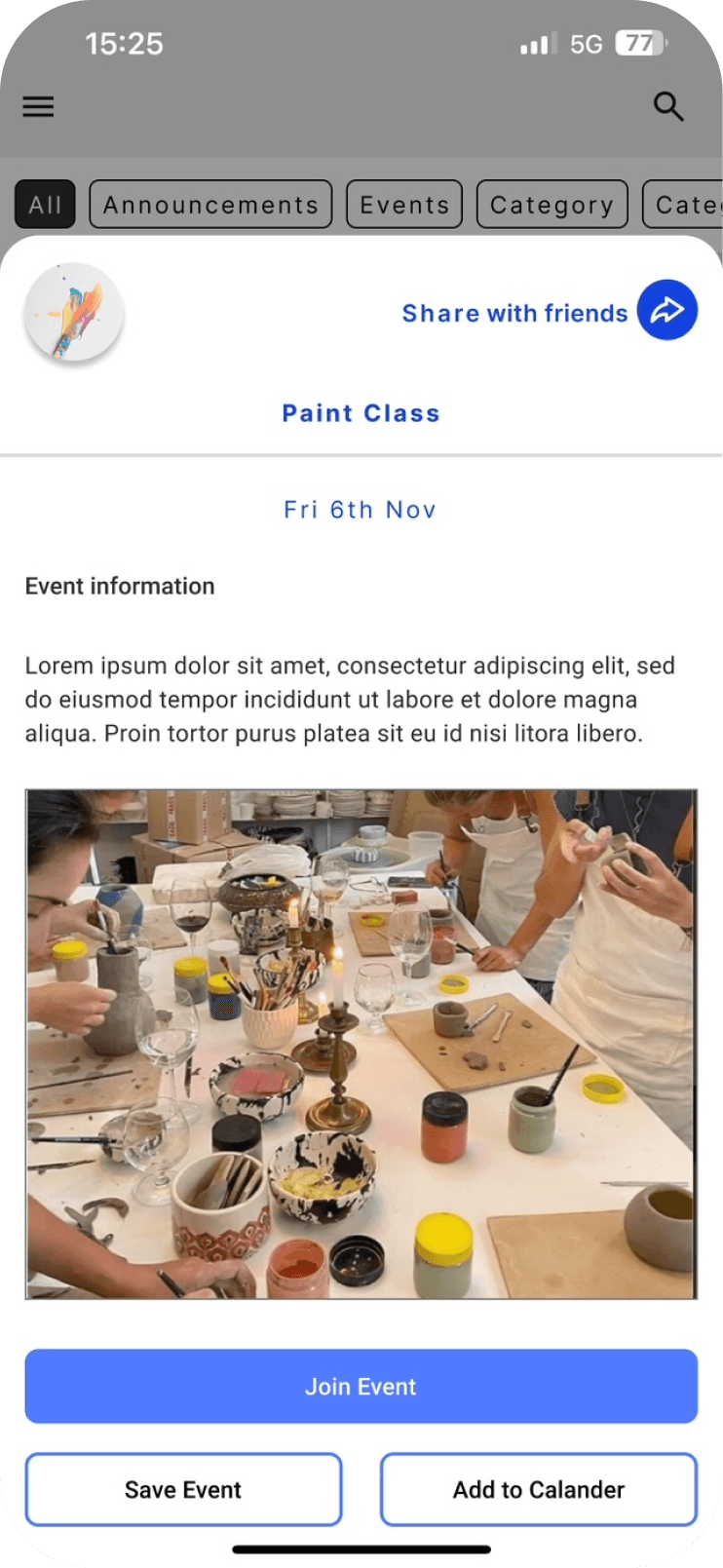
Concept 2: Community Committee
Concept 2: Community Committee
A peer-led platform where Gen Z vote on events and changes they want to see in their community, giving people a voice locally while creating space to meet others around shared interests.
A peer-led platform where Gen Z vote on events and changes they want to see in their community, giving people a voice locally while creating space to meet others around shared interests.
Concept 3: Battleship Cans
Concept 3: Battleship Cans
A physical game using recycled cans as game pieces. No app required to play, a fun interactive game, and a reason to talk to whoever's nearby.
It leaned into a nostalgia both Gen Z and millennials recognised, the childhood game Battleship, rebuilt as something to set up anywhere people already gather: a fresher's week stand, a common room, a public space.
A physical game using recycled cans as game pieces. No app required to play, a fun interactive game, and a reason to talk to whoever's nearby.
It leaned into a nostalgia both Gen Z and millennials recognised, the childhood game Battleship, rebuilt as something to set up anywhere people already gather: a fresher's week stand, a common room, a public space.

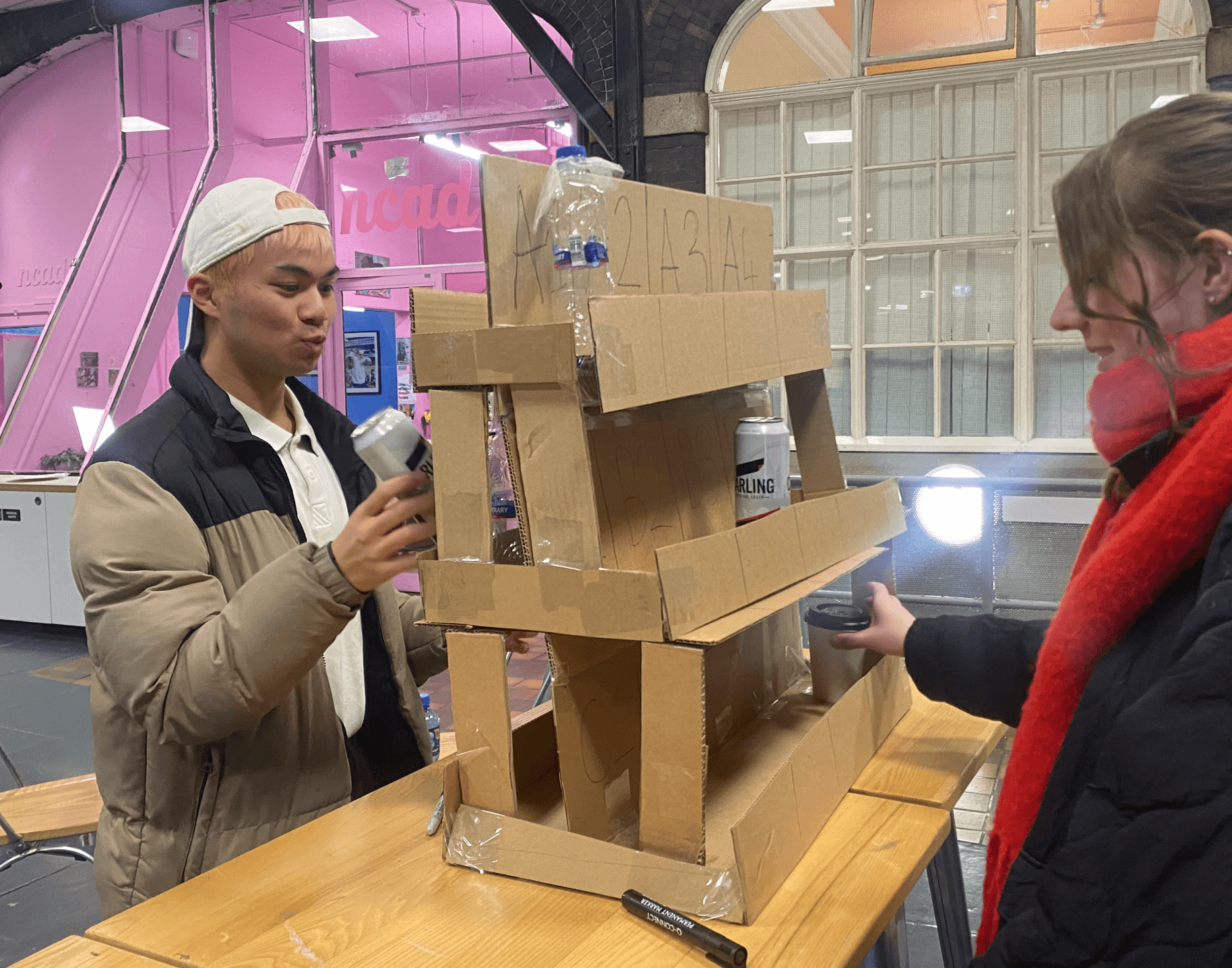
“I’d see myself challenging people to a game. It’s a really good laugh”
“I’d see myself challenging people to a game. It’s a really good laugh”
“I’d see myself challenging people to a game. It’s a really good laugh”
- Gen Z participant
- Gen Z participant
- Gen Z participant
Why Battleship Cans moved forward
Why Battleship Cans moved forward
All three were prototyped and tested with real users. Community Committee and TryPal both tested well, but both depended on an app before any actual interaction could happen, the connection only started after someone downloaded something.
Battleship Cans didn't have that barrier. In testing, it created interaction immediately and naturally: people got curious, asked what was going on, and joined in without needing to install anything first. That difference, interaction with no app required to start, was the reason it moved forward.
All three were prototyped and tested with real users. Community Committee and TryPal both tested well, but both depended on an app before any actual interaction could happen, the connection only started after someone downloaded something.
Battleship Cans didn't have that barrier. In testing, it created interaction immediately and naturally: people got curious, asked what was going on, and joined in without needing to install anything first. That difference, interaction with no app required to start, was the reason it moved forward.
Development
User Testing
User Testing
Getting the game design right: Tested by Gen Z
Getting the game design right: Tested by Gen Z
Round 1: Testing other game versions
Round 1: Testing other game versions
We tested a simpler version using X’s and O’s with cans, but dropped it because games ended too quickly. The goal was conversation, not speed.
We tested a simpler version using X’s and O’s with cans, but dropped it because games ended too quickly. The goal was conversation, not speed.

Round 2: What we cut
Round 2: What we cut
We tested a companion app with a digital leaderboard, but it made things worse. Instead of encouraging interaction, it became a barrier between players, so we removed it.
The game was too tall, making it hard for players to see each other and keep conversations going, so we adjusted.
We tested a companion app with a digital leaderboard, but it made things worse. Instead of encouraging interaction, it became a barrier between players, so we removed it.
The game was too tall, making it hard for players to see each other and keep conversations going, so we adjusted.

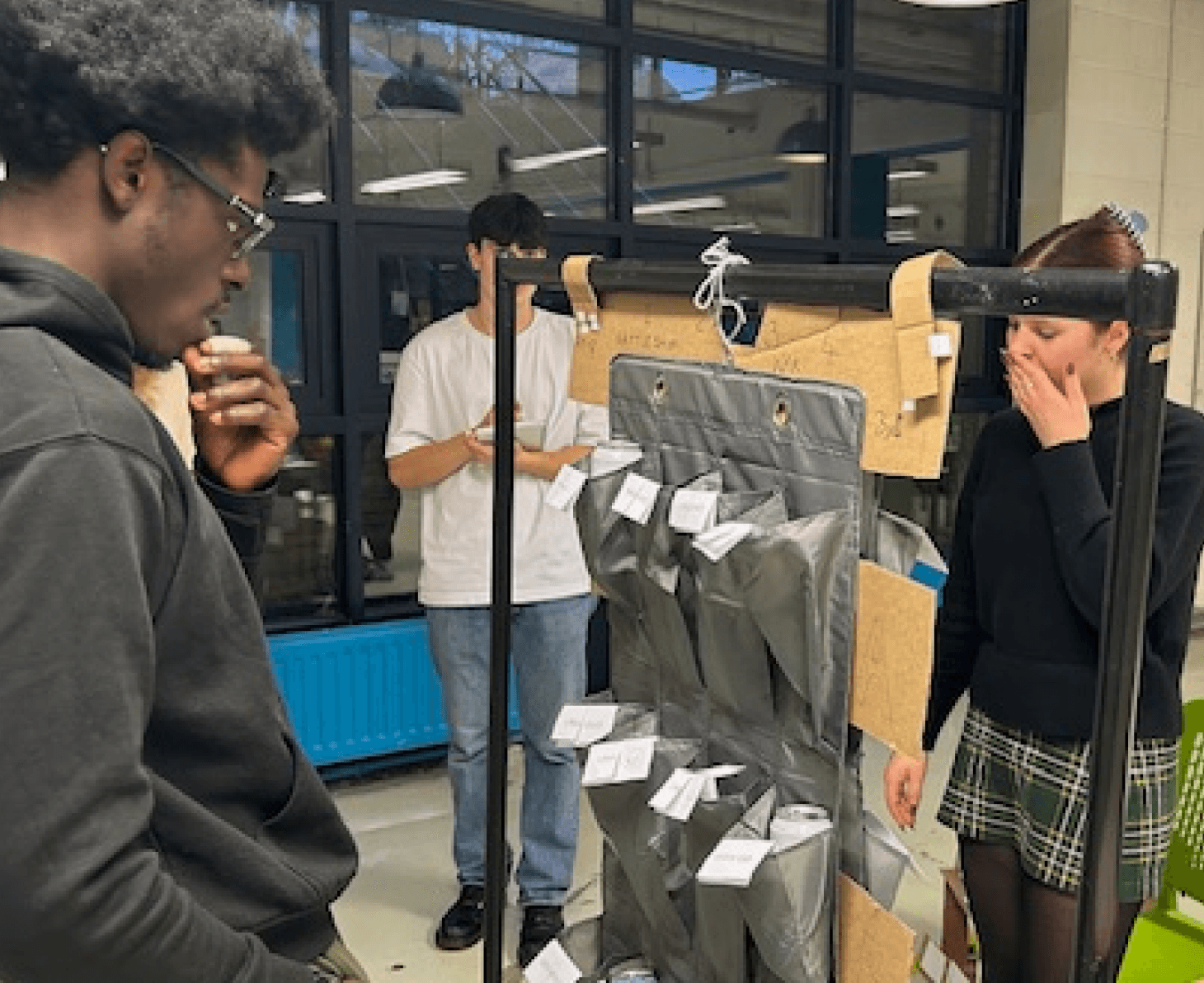

Round 3: Adding to the design
Round 3: Adding to the design
We added icebreaker questions to the hit mechanic. The game brought strangers together, but the questions helped turn that proximity into conversation and move past the initial awkwardness.
We added icebreaker questions to the hit mechanic. The game brought strangers together, but the questions helped turn that proximity into conversation and move past the initial awkwardness.


The Design
The Design
From testing feedback to a finished product
From testing feedback to a finished product
Three rounds of testing shaped every decision in the final build. What started as a rough prototype became a considered, finished product through planning, making, and iteration.
Three rounds of testing shaped every decision in the final build. What started as a rough prototype became a considered, finished product through planning, making, and iteration.

How it works
How it works
Players hide their cans on their side of the board
Take turns guessing where the other player's cans are placed
A hit means answering an icebreaker question from the board
First to find all the opponent's cans wins
The questions weren't decorative. They were the mechanic that turned a game into a conversation.
Players hide their cans on their side of the board
Take turns guessing where the other player's cans are placed
A hit means answering an icebreaker question from the board
First to find all the opponent's cans wins
The questions weren't decorative. They were the mechanic that turned a game into a conversation.

The final product
The final product
Built to be set up anywhere people already gather: a fresher's week campus stand, a common room, a public space. Any canned drink works, the game doesn't depend on alcohol to function.
Built to be set up anywhere people already gather: a fresher's week campus stand, a common room, a public space. Any canned drink works, the game doesn't depend on alcohol to function.


Storyboard
Storyboard
From a game to a friendship
From a game to a friendship

Reason to approach
Reason to approach
The game creates a natural opening. No cold introduction needed.
The game creates a natural opening. No cold introduction needed.

A reason to talk
A reason to talk
Icebreaker questions keep the conversation moving past the first exchange.
Icebreaker questions keep the conversation moving past the first exchange.

A reason to stay
A reason to stay
When the game ends. The conversation doesn't have to, stay and connect.
When the game ends. The conversation doesn't have to, stay and connect.
Outcome
Outcome
Tested with real students, on a real campus
Tested with real students, on a real campus
Students engaged with it immediately. Conversations started without prompting, new people walked over to ask what was going on and wanted a turn. The connection happened in a way that felt natural.
Students engaged with it immediately. Conversations started without prompting, new people walked over to ask what was going on and wanted a turn. The connection happened in a way that felt natural.
Presented to Accenture The Dock
Presented to Accenture The Dock
The reaction was genuinely positive. Accenture could see a real future for it: set up on campuses during fresher's week, placed in public spaces, run with any canned drink, not just alcohol.
Their main concern wasn't the concept. It was scale, what it would take to run this across multiple locations consistently.
The reaction was genuinely positive. Accenture could see a real future for it: set up on campuses during fresher's week, placed in public spaces, run with any canned drink, not just alcohol.
Their main concern wasn't the concept. It was scale, what it would take to run this across multiple locations consistently.
What it proved
What it proved
You don't need an app to get Gen Z talking to strangers. You need something physical, something low-pressure, and something that removes the moment of having to make the first move alone.
Battleship Cans answered all four things research told us mattered: it gave people a reason to approach without the anxiety of a cold introduction, it felt like a natural interaction rather than an engineered one, it activated a space that already existed but wasn't being used, and it turned the litter problem into the reason to stay.
You don't need an app to get Gen Z talking to strangers. You need something physical, something low-pressure, and something that removes the moment of having to make the first move alone.
Battleship Cans answered all four things research told us mattered: it gave people a reason to approach without the anxiety of a cold introduction, it felt like a natural interaction rather than an engineered one, it activated a space that already existed but wasn't being used, and it turned the litter problem into the reason to stay.
Key Learnings
Key Learnings
A good insight should change what you build. The littering finding wasn't background context, it became the literal mechanic of the game.
Cut what gets in the way of the goal. The app felt like an strong feature. Testing showed it worked against the actual goal, connection.
Test with real people, not assumptions. Testing reveals what your design actually performs, you can’t recreate it in studio.
A good insight should change what you build. The littering finding wasn't background context, it became the literal mechanic of the game.
Cut what gets in the way of the goal. The app felt like an strong feature. Testing showed it worked against the actual goal, connection.
Test with real people, not assumptions. Testing reveals what your design actually performs, you can’t recreate it in studio.
MORE PROJECTS

